Edited by Hong-Bin Yoon · Founder, zzinDev LLC
Published
Spirited Away Season 1 Recap
Spoiler Alert: This recap contains detailed plot summaries and may reveal key story events.
TL;DR
Spirited Away is Hayao Miyazaki’s masterpiece — a coming-of-age fantasy about a sulky 10-year-old girl trapped in a spirit world bathhouse who must find the courage to save her parents and herself. It’s equal parts terrifying and tender, packed with unforgettable imagery, and it earned every bit of its Academy Award. If you’ve never seen it, stop reading and go watch it. If you have, you already know why it’s here.
Season Summary
As a standalone film rather than a traditional season, Spirited Away unfolds as one continuous journey. This Spirited Away season 1 recap breaks the story into its major narrative arcs for clarity.
The Crossing Into the Spirit World
The film opens with Chihiro Ogino slumped in the backseat of her parents’ car, miserable about moving to a new town. She clutches a wilting bouquet of goodbye flowers — a small, perfect detail that tells you everything about her state of mind.
Her father takes a wrong turn and discovers what appears to be an abandoned theme park beyond a mysterious tunnel. Despite Chihiro’s protests, her parents explore the empty streets and find a stall overflowing with fresh food. They start eating greedily, assuming they can pay later. Chihiro wanders off alone, discovering a massive bathhouse and a bridge over a vast expanse of water.
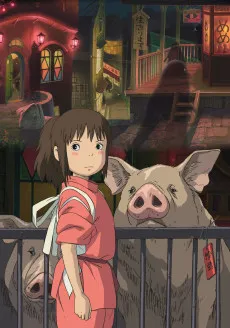
A boy named Haku finds her and urgently tells her to leave before dark. But it’s already too late. As night falls, shadowy spirits begin materializing everywhere, and when Chihiro runs back to her parents, she finds them transformed into pigs — punishment for eating food meant for the spirits. The river crossing floods, and Chihiro is stranded. She begins to fade, literally becoming transparent, until Haku finds her again and feeds her food from the spirit world to keep her from disappearing entirely.
Working in Yubaba’s Bathhouse (The Contract)
Haku instructs Chihiro to seek employment from Yubaba, the witch who runs the bathhouse. This is the only way to survive in the spirit world. The bathhouse itself is an extraordinary creation — a towering, multi-storied Japanese inn that serves as a spa for gods and spirits of every description.
Yubaba is terrifying: an enormous-headed old woman with powerful magic and a foul temper. She tries to intimidate Chihiro into giving up, but the girl stubbornly insists on working. Yubaba agrees — and as part of the contract, steals most of Chihiro’s name, renaming her “Sen.” Haku later warns her that forgetting her real name means she can never leave, just as it happened to him. This detail becomes critical later.
Sen begins work under Rin, a no-nonsense bathhouse worker who initially resents the human girl but gradually becomes her ally and protector. Down in the boiler room, the six-armed spider-like Kamajii runs the furnace with the help of tiny soot sprites. He’s gruff but kind, and he’s the first to vouch for Sen when she needs help. The bathhouse workers are initially hostile — humans stink to spirits, they say — but Sen slowly earns grudging respect.
The Stink Spirit and No-Face (Proving Herself)
Sen’s first major test comes when an impossibly foul “stink spirit” arrives at the bathhouse. Every other worker flees, but Yubaba assigns the job to Sen. As Sen works to bathe the creature, she discovers something lodged in its body — a bicycle handle. She pulls, and an avalanche of garbage and pollution pours out. The stink spirit was actually a powerful river god, polluted beyond recognition. Cleansed, it departs joyfully, leaving behind a precious herbal cake as thanks. This moment earns Sen real respect in the bathhouse and demonstrates the film’s environmental themes.
Meanwhile, a strange masked spirit called No-Face slips into the bathhouse after Sen kindly holds the door open for him. No-Face is lonely and desperate for connection. He discovers he can conjure gold from his hands, and the bathhouse workers fall over themselves to serve him. But the gold is an illusion, and No-Face grows increasingly monstrous the more he consumes — swallowing workers whole, demanding more food, more attention, more everything.
No-Face's Rampage
No-Face becomes a bloated, terrifying giant, consuming everything and everyone in his path. He fixates on Sen, the only person who showed him genuine kindness without wanting anything in return. Sen feeds him the remainder of the river god's herbal cake, causing him to vomit up everything and everyone he consumed. Stripped back to his small, quiet form, he follows Sen out of the bathhouse — finding peace only when removed from the environment that corrupted him.Haku’s Secret and the Journey to Zeniba
Throughout the film, Haku has been Chihiro’s protector, but his own story runs parallel. He serves as Yubaba’s apprentice and enforcer, carrying out tasks he clearly finds distasteful. When he returns from a mission to Yubaba’s twin sister Zeniba, he’s badly wounded — attacked by paper shikigami and bleeding. In his dragon form, he crashes into the bathhouse, and Sen follows him, desperately trying to help.
Sen feeds Haku the last of the herbal cake, saving his life. She then learns that Haku stole a powerful magic seal from Zeniba, and a deadly curse on the seal is killing him. Sen resolves to visit Zeniba herself to return the seal and beg forgiveness on Haku’s behalf. Kamajii gives her train tickets he’s kept for forty years, and Sen boards a mysterious one-way train across a vast, shallow ocean — one of the most hauntingly beautiful sequences in all of animation.
Zeniba's Revelation
Zeniba, despite being Yubaba's twin, is warm and grandmotherly. She tells Sen that the curse has already been broken by Sen's love for Haku. She also reveals that Yubaba's enormous baby, Boh — who was transformed into a mouse by Zeniba earlier — has been traveling with Sen the entire time, and the experience has been good for him. Zeniba gives Sen a hair tie woven by her friends as protection.The Final Test (Remembering and Returning Home)
Haku arrives at Zeniba’s cottage in dragon form to bring Sen home. As they fly back together, Chihiro suddenly remembers something: as a small child, she fell into a river called the Kohaku River. The water carried her safely to shore. Haku is the Kohaku River — his full name is Kohaku Nushi, the river spirit. His river was drained and paved over for apartments, leaving him without a home, which is how he ended up under Yubaba’s control. When Chihiro speaks his true name, his dragon scales fall away and they float together in the sky, both crying.
Back at the bathhouse, Yubaba sets one final condition: Sen must identify her parents among a group of pigs. Chihiro calmly answers that none of them are her parents. It’s the right answer. The contract dissolves, and she is Chihiro again.
Haku walks her to the edge of the spirit world, promising they’ll meet again. Chihiro crosses back through the tunnel to find her parents waiting by the car, remembering nothing. The car is covered in dust and leaves — time has passed differently. As they drive away to their new home, Chihiro looks back one last time. She doesn’t fully remember what happened, but she’s changed. The sulky child from the opening is gone. In her hair, Zeniba’s hair tie glitters.
Highlights & Must-See Moments
- The River God Bathhouse Scene — Sen pulling an endless stream of human garbage from the stink spirit is both disgusting and triumphant, a perfect metaphor wrapped in spectacle.
- The Train Ride Over the Sea — Silent, dreamlike, and achingly beautiful. Joe Hisaishi’s piano score does all the talking. This scene alone justifies the film’s existence.
- Chihiro Remembers Haku’s Name — The emotional climax. The animation of their free-fall through open sky, scales peeling away, is breathtaking in its tenderness.
- No-Face’s Corruption — A quietly devastating portrayal of loneliness and consumerism run amok, animated with escalating horror that never feels gratuitous.
- The Final Pig Test — After everything Chihiro has endured, she doesn’t even hesitate. “None of them are my parents.” The growth is complete.
Our Take
Spirited Away remains the gold standard for animated storytelling, and this Spirited Away season 1 summary only scratches the surface of its depth. Where most fantasy films are about a hero gaining power, Miyazaki’s film is about a child gaining composure. Chihiro doesn’t learn magic, find a weapon, or unlock hidden abilities. She learns to work hard, to be polite to terrifying people, and to keep going when everything is strange and frightening. That’s a radical message for any film, let alone one marketed to children.
The film draws obvious comparisons to Alice in Wonderland, but it’s more spiritually aligned with Japanese folklore — the bathhouse is a yōkai ecosystem, and the story’s moral framework is Shinto at its core: respect for nature, the importance of names, the corruption of greed. It swept the Academy Award for Best Animated Feature in 2003, remains the highest-grossing film in Japanese history (until Demon Slayer briefly overtook it), and has influenced everything from Pixar’s storytelling to indie game design. Twenty-five years on, nothing has matched it.
Rating: 9.5 / 10 — A once-in-a-generation masterpiece that rewards every rewatch.
Where to Watch & Read
- Watch on Max
- Watch on Netflix
- This is an original film by Studio Ghibli (no source manga or novel)
- Spirited Away (Blu-ray + DVD) by Studio Ghibli — Shop on Amazon
- No-Face Spirited Away Pop! Vinyl Figure — Shop on Amazon