Edited by Hong-Bin Yoon · Founder, zzinDev LLC
Published
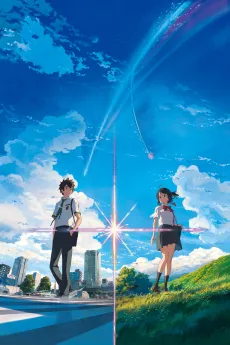
Your Name. Season 1 Recap
Spoiler Alert: This recap contains detailed plot summaries and may reveal key story events.
TL;DR
Your Name. (Kimi no Na wa.) is Makoto Shinkai’s masterpiece — a breathtaking supernatural romance about two teenagers who mysteriously swap bodies across time and space. What starts as a charming body-swap comedy evolves into a devastating race against fate, blending stunning visuals with an emotionally devastating story about connection, memory, and loss. This isn’t just one of the best anime films ever made — it’s one of the best animated films, period. If you haven’t seen it yet, stop reading and go watch it.
Season Summary
As a standalone film rather than a seasonal anime, this Your Name. season 1 recap covers the full movie from start to finish, broken into its major story arcs.
The Body Swap (Opening – ~30 min)
Mitsuha Miyamizu is a high school girl living in the rural town of Itomori, nestled in the mountains around a pristine lake. She’s bored. She helps her grandmother Hitoha with their family shrine, endures her estranged father’s political career, and wishes aloud that she could be reborn as a handsome Tokyo boy. Her little sister Yotsuha thinks she’s lost it.
Meanwhile, Taki Tachibana is a high school boy in Tokyo juggling school, a part-time job at an Italian restaurant, and a quiet crush on his coworker, the older Ms. Okudera. One morning, each wakes up in the other’s body — Mitsuha in Taki’s Tokyo apartment, Taki in Mitsuha’s rural bedroom. Confusion and comedy ensue.
They establish rules through notes on each other’s phones and written on their hands and faces. Mitsuha-as-Taki charms Okudera and impresses Taki’s friends with “his” new gentleness. Taki-as-Mitsuha becomes something of a local legend in Itomori for “her” sudden boldness. The swaps happen intermittently — a few times a week — and their memories of each swap fade like a dream upon waking, making the phone notes essential.
Growing Connection (Middle Act)
As weeks pass, the swaps become a rhythm. Despite the chaos they cause in each other’s lives, Mitsuha and Taki develop a deep, unspoken bond. Mitsuha successfully sets Taki up on a date with Okudera, though she feels a pang of jealousy she can’t quite name. Taki becomes more curious about Mitsuha’s life, her family’s shrine traditions, and the concept of musubi — the braided cords that represent the flow of time and human connection, as explained by Grandmother Hitoha.
A pivotal moment comes when Mitsuha, in Taki’s body, meets Okudera for the date she arranged. The date goes poorly — Okudera can tell “Taki” isn’t himself. That evening, Taki (back in his own body) calls Mitsuha’s number, but can’t get through. He steps onto a Tokyo overpass at twilight — the magical hour — and they almost connect by phone. Mitsuha, watching the comet Tiamat streak across the Itomori sky, makes a choice. She cuts her hair and sends Taki her braided cord as a keepsake.
Then the swaps stop. Completely.
The Search for Mitsuha (~60–80 min)
Taki is haunted by fading memories of a girl whose name he can no longer remember. Driven by sketches he drew from memory of Itomori’s landscape, he drags his friends Tsukasa and Okudera on a trip to find the town. Nobody recognizes his drawings. Nobody has heard of the place.
Major Spoiler — The Comet
A ramen shop owner finally recognizes Taki’s sketches — it’s Itomori. But Itomori was destroyed three years ago. Comet Tiamat split apart during its passing, and a fragment struck the town during the autumn festival, killing over 500 people. Taki realizes with horror that Mitsuha has been dead for three years. The body swaps were happening across time — he in 2016 Tokyo, she in 2013 Itomori. The date discrepancy was always there in their phone notes, but the dream-like haze of each swap kept them from noticing.
Taki refuses to accept this. He travels to the ruins of Mitsuha’s family shrine at the summit of a mountain caldera, a sacred place where the “other world” is close. He drinks the kuchikamizake — ritual sake Mitsuha brewed — as an offering, hoping to reach her across time.
Twilight on the Mountain (Climax)
Major Spoiler — The Reunion
The sake triggers one final swap. Taki wakes in Mitsuha’s body on the morning of the festival — the day of the comet strike. He has hours to save the town. He enlists Mitsuha’s friends Teshigawara and Sayaka to help evacuate Itomori by sabotaging the town’s electrical substation and broadcasting a fake emergency alert. Mitsuha’s father, the mayor, is the key — only he has the authority to order a real evacuation.
Meanwhile, Mitsuha’s consciousness wakes at the shrine summit in Taki’s body. They are separated by three years and the width of a mountain. As twilight falls — kataware-doki, the magic hour when the boundary between worlds thins — they can see each other across the crater. For a single, stunning moment, they exist in the same time and place.
They reach for each other. They speak. They decide to write each other’s names on their hands so they won’t forget. Taki writes on Mitsuha’s palm. Before Mitsuha can finish writing on Taki’s, twilight ends. She vanishes. Taki looks at his hand — she wrote “I love you” instead of her name.
The Resolution (Final Act)
Major Spoiler — Does the Town Survive?
Mitsuha, back in her own body and time, races downhill toward Itomori. Her memory of Taki fades with every step. She trips, falls, looks at her hand — the writing is gone. She can’t remember why she’s running. But something in her heart won’t let her stop. She confronts her father. The details are left ambiguous, but we see the town evacuated. The comet fragment destroys Itomori — but the death toll is zero. She saved everyone.
Years pass. Taki and Mitsuha grow into young adults in Tokyo, unable to remember each other but carrying an inexplicable sense of loss. They feel it on train platforms, in crowded streets, in the ache of twilight. One spring day, their trains pass on parallel tracks. They lock eyes through the windows. They race to find each other through Tokyo’s winding staircases and streets.
On a long stone staircase, they meet. Tears streaming, not knowing why, they ask each other the same question: “What’s your name?”
Highlights & Must-See Moments
- The First Swap Morning — Taki groping Mitsuha’s chest in confused disbelief sets the tone perfectly, balancing comedy with genuine bewilderment.
- The Comet over Itomori — The moment Tiamat streaks across the night sky is one of the most visually stunning sequences in anime history, elevated by RADWIMPS’ soaring score.
- The Twist Reveal — Learning that Itomori was destroyed three years ago recontextualizes the entire film in an instant. The emotional floor drops out.
- Kataware-doki on the Mountain — Mitsuha and Taki’s twilight reunion is the emotional apex of the film. Brief, desperate, and unforgettable.
- The Staircase Ending — “What’s your name?” delivered through tears is the perfect final line, completing the film’s central motif with devastating simplicity.
Our Take
Your Name. succeeded because Makoto Shinkai finally married his trademark visual poetry with a story that earns its emotional weight. His earlier works — 5 Centimeters Per Second, The Garden of Words — were gorgeous but sometimes felt like mood pieces in search of a narrative. Here, the body-swap mechanic provides structure and momentum, the time-gap twist provides stakes, and the musubi mythology grounds the supernatural elements in something culturally resonant. The RADWIMPS soundtrack isn’t just accompaniment — tracks like “Sparkle” and “Nandemonaiya” are load-bearing emotional architecture.
The film’s cultural impact is hard to overstate. It became the highest-grossing anime film worldwide at the time, surpassing every Miyazaki film, and sparked a global conversation about anime as mainstream cinema. It’s frequently compared to Ghibli’s best, but Shinkai’s sensibility is distinctly modern — smartphones, social media, the loneliness of digital-age connection. If Weathering with You and Suzume expanded his ambitions, Your Name. remains the purest distillation of what makes Shinkai’s work resonate.
Rating: 9.3 / 10 — A landmark in anime cinema that earns every tear it wrings from you.
Where to Watch & Read
- Watch on Netflix
- This film is an original anime by Makoto Shinkai, later adapted into print
- Your Name. Novel by Makoto Shinkai — Shop on Amazon
- Your Name. Manga Box Set by Ranmaru Kotone — Shop on Amazon
- Your Name. Visual Guide Book — Shop on Amazon