Edited by Hong-Bin Yoon · Founder, zzinDev LLC
Published
LOOK BACK Season 1 Recap
Spoiler Alert: This recap contains detailed plot summaries and may reveal key story events.
TL;DR
Look Back is a 58-minute anime film adapted from Tatsuki Fujimoto’s acclaimed one-shot manga — a gut-punch meditation on creativity, friendship, loss, and the reason we keep making art. Following two young manga artists from childhood through tragedy, it delivers more emotional weight in under an hour than most series manage across full seasons. If you’ve ever created anything and wondered whether it mattered, this film will wreck you in the best possible way. An absolute must-watch and one of the standout anime releases of 2024.
Season Summary
This Look Back season 1 recap covers the complete film, which tells a self-contained story across three distinct emotional movements. Though technically a feature film rather than a traditional season, Look Back functions as a complete narrative arc — no sequel required, no cliffhanger endings.
Act I — The Rivalry (Opening – ~20 min)
Ayumu Fujino is a cocky fourth-grader and the undisputed art star of her class. She draws a regular 4-panel manga strip for the school newspaper, and her classmates shower her with praise. Life is good — until her teacher casually mentions that Kyomoto, a mysterious student who refuses to attend school, also wants to contribute a strip.
When Kyomoto’s manga appears in the next issue alongside Fujino’s, the classroom dynamic shifts instantly. Kyomoto’s art is breathtaking — detailed, realistic backgrounds that make Fujino’s cartoonish panels look like amateur doodles. Classmates begin fawning over Kyomoto’s work instead. Fujino’s pride shatters.
What follows is a montage of obsessive self-improvement that any creative person will recognize. Fujino throws herself into studying art. She fills sketchbook after sketchbook, practices through seasons, studies anatomy and perspective. Years pass. She improves dramatically — but every time the school newspaper comes out, Kyomoto’s art is still leagues ahead. Eventually, defeated and bitter, Fujino quits drawing entirely.
Act II — The Partnership (~ 20–40 min)
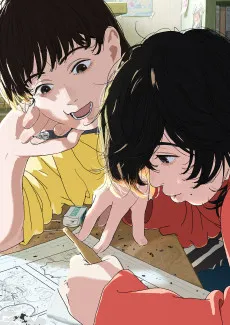
On elementary school graduation day, Fujino’s teacher asks her to deliver Kyomoto’s diploma since Kyomoto still won’t come to school. Fujino trudges to Kyomoto’s house and slips the diploma certificate under the bedroom door. On a whim — or maybe out of lingering pride — she doodles a quick 4-panel strip on the back.
The door opens. Kyomoto stands there, shy and disheveled from years of isolation, clutching Fujino’s strip. And then she says the words that change everything: she’s been a fan of Fujino’s manga this whole time. She thinks Fujino is incredible. To Kyomoto, trapped alone in her room, those simple 4-panel comics in the school paper were a lifeline — the funniest, most alive thing she’d ever read.
Fujino is stunned. The girl whose technical mastery crushed her spirit has been looking up to her all along. In one of the film’s most joyful sequences, the two girls run through the streets together in the rain, giddy with the kind of creative connection that only happens once in a lifetime. They become inseparable. Fujino handles story and characters; Kyomoto handles backgrounds and environments. Together, they’re unstoppable — submitting manga to competitions, winning awards, and eventually landing a professional serialization while still in school.
But as high school ends, their paths diverge. Fujino wants to go pro full-time. Kyomoto wants to attend art university to study formally. They part ways — not with drama, but with the quiet ache of two people who’ve outgrown a shared dream. Fujino continues her serialization alone. Kyomoto enrolls in art school.
Act III — The Loss (~40 min – End)
Major Spoiler — The Central Tragedy
A news broadcast stops Fujino cold. A violent attacker has stormed an art university — Kyomoto’s university. Multiple people are dead. Kyomoto is among the victims.
The film handles this devastating event with restraint. There is no graphic depiction — just the slow, crushing weight of absence. Fujino learns the news the way most people learn terrible news: from a screen, too late to do anything.
Fujino spirals into grief and guilt. Her mind runs the terrible calculus of “what if”: What if she had never drawn that 4-panel strip? What if Kyomoto had never opened that door? What if Kyomoto had never been inspired to pursue art, had never gone to that school? The art that brought them together now feels like the thing that led to Kyomoto’s death.
Major Spoiler — The Alternate Timeline
In the film’s most ambitious and emotionally devastating sequence, we see an alternate reality. A world where Fujino’s manga strip doesn’t reach Kyomoto — where she never opens the door, never partners with Fujino, never attends art school. In this timeline, Kyomoto is alive. But she’s also still trapped in her room, alone, without the friendship and creative fulfillment that defined her life.
The sequence is deliberately ambiguous — is this Fujino’s fantasy? A genuine parallel reality? The manga strip seems to transcend timelines, blowing through doors and across realities. It’s a beautiful, painful visualization of the impossible bargain grief demands: would you undo the best thing in someone’s life to keep them alive?
The film’s resolution is quiet and devastating. Fujino returns to Kyomoto’s room and discovers that Kyomoto had pinned every single one of Fujino’s 4-panel strips to her wall. All those comics Fujino thought were embarrassing, that she quit over, that she considered worthless compared to Kyomoto’s talent — Kyomoto treasured them all. This Look Back season 1 summary wouldn’t be complete without noting the title’s double meaning: “look back” as in reflecting on the past, and the Japanese wordplay on watching someone’s back as they walk ahead — admiring, following, being inspired.
Fujino sits down at her desk. She picks up her pen. She draws — not because it will bring Kyomoto back, but because creating is how she honors what they built together. The film ends as it began: with a girl drawing manga. But now every line carries the weight of everything she’s lost and everything that mattered.
Highlights & Must-See Moments
- The Rain Sequence — Fujino and Kyomoto running through the streets after their first meeting is pure animated joy, a sequence that captures the electricity of finding your creative soulmate.
- The Montage of Obsession — Fujino’s years-long training arc is one of the most honest depictions of artistic jealousy and self-improvement in any anime, condensed into minutes of wordless storytelling.
- The Door Opens — The moment Kyomoto finally opens her bedroom door is the film’s emotional hinge point, turning rivalry into partnership with a single revelation.
- The Alternate Timeline Sequence — A formally daring, heartbreaking what-if that asks whether the best moments of someone’s life are worth the risk that enabled them.
- The Final Drawing — Fujino returning to her desk in the closing moments delivers the film’s thesis with zero dialogue and maximum impact.
Our Take
Look Back stands alongside films like A Silent Voice and Grave of the Fireflies in the pantheon of anime that achieve maximum emotional devastation with minimal runtime. What makes it exceptional is how specifically it speaks to creators — this isn’t generic grief; it’s the particular guilt of wondering whether your influence in someone’s life led them somewhere dangerous. Tatsuki Fujimoto (of Chainsaw Man fame) wrote the source manga as a response to the Kyoto Animation tragedy of 2019, and that raw, personal urgency translates fully to the screen.
Director Kiyotaka Oshiyama and Studio DURIAN make every frame count. The animation shifts styles to match emotional registers — loose and energetic during the partnership years, stark and suffocating during the grief. At 58 minutes, it’s a masterclass in economy. Not a single scene is wasted. In a medium that often stretches stories past their breaking point, Look Back proves that the bravest creative choice is sometimes knowing exactly when to stop.
Rating: 9.2 / 10 — A devastating, essential work of anime filmmaking that earns every tear it wrings from you.
Where to Watch & Read
- Watch on Amazon Prime Video
- Source: Manga (one-shot by Tatsuki Fujimoto)
- Look Back by Tatsuki Fujimoto Manga — Shop on Amazon
- Look Back Blu-ray — Shop on Amazon