Edited by Hong-Bin Yoon · Founder, zzinDev LLC
Published
Clannad Season 2 Recap
Spoiler Alert: This recap contains detailed plot summaries and may reveal key story events.
TL;DR
Clannad: After Story picks up where the first season left off and follows Tomoya and Nagisa beyond high school into adulthood — jobs, marriage, parenthood, and devastating loss. This is the season that earned Clannad its legendary reputation. If the first season made you smile, After Story will absolutely destroy you and then piece you back together in the most cathartic way possible. Widely considered one of the greatest anime dramas ever made, this Clannad: After Story season 1 recap covers the full emotional gauntlet from start to finish. Bring tissues. Lots of them.
Season Summary
This Clannad: After Story season 1 summary covers the complete journey across all 24 episodes — from the final days of high school through the supernatural conclusion that ties together every thread the series has woven.
Lingering School Days & Side Stories (Episodes 1–8)
After Story opens with several character-focused arcs that serve as a bridge between high school life and the adult story to come. The first arc centers on Youhei Sunohara and his younger sister Mei, who visits worried about her brother’s aimless lifestyle. Tomoya and Mei scheme to snap Sunohara out of his funk, but the plan spirals when Sunohara fails to recognize what truly matters — his sister’s feelings. It culminates in an emotional confrontation that tests the bond between the Sunohara siblings and reinforces the series’ core theme: family is everything.
Episodes 4–5 tell the story of Misae Sagara, the dorm mother at Tomoya’s residence. Through a dreamlike flashback, we learn about her high school romance with a mysterious boy named Shima and the wish he made on her behalf. The arc is bittersweet and quietly introduces the supernatural “light orbs” mechanic — orbs of happiness born from fulfilled wishes — that becomes critical later.
The Yukine Miyazawa arc (Episodes 6–8) takes an unexpected turn into gang territory. Yukine has been secretly caring for injured gang members in the school’s reference room, and when her brother Kazuto’s rival gang escalates tensions, Tomoya steps in. What follows is a surprisingly physical storyline with Tomoya fighting to broker peace, ending with a revelation about Kazuto that brings both gangs together in grief and reconciliation.
Graduation & Stepping Into Adulthood (Episodes 9–13)
This is where After Story begins to distinguish itself from virtually every other romance anime. Nagisa’s chronic illness forces her to repeat her senior year again, and Tomoya graduates without her. Suddenly he’s in the real world — no safety net, no drama club, no school friends down the hall.
Tomoya takes a job as an electrician’s apprentice under Yoshino Yusuke, Fuko’s brother-in-law. The work is grueling and unglamorous, but Yoshino becomes a quiet mentor figure. Meanwhile, Tomoya waits for Nagisa to finish school, and when she finally graduates, it’s one of the most earned emotional payoffs in the series — the play she never got to perform, finally realized.
Tomoya proposes. They move into their own apartment. It’s small and modest, but it’s theirs. These episodes are remarkable for how honestly they portray the mundane beauty and anxiety of early adulthood — paying bills, navigating in-laws, building a life from nothing. Akio and Sanae Furukawa, Nagisa’s parents, remain a warm presence, though Tomoya’s relationship with his own father Naoyuki continues to be a source of pain. What happens in Clannad: After Story season 1 is ultimately a story about breaking — and healing — cycles of broken fatherhood.
The Birth & The Loss (Episodes 14–16)
Nagisa becomes pregnant, and joy mixes with dread. Her health has always been fragile, and the pregnancy takes a severe toll. Tomoya and the Furukawas face an agonizing reality: carrying the baby to term is dangerous.
Nagisa insists on having the child. The birth scene, set during a brutal winter snowstorm, is among the most devastating sequences in anime history.
Major Spoiler — Episode 16
Nagisa gives birth to a daughter, Ushio, but does not survive. She dies holding her newborn child while Tomoya watches helplessly. The scene is drawn out, quiet, and unflinching — Kyoto Animation lets every second of grief land. Tomoya is shattered.What follows is a time skip. Five years pass in near-silence. Tomoya has become a hollow version of himself — going through the motions at work, drinking, completely absent from his daughter’s life. Ushio has been raised by Akio and Sanae. Tomoya has become the very thing he despised: a neglectful father, repeating his own father’s mistakes.
The Flower Field — Father & Daughter (Episodes 17–19)
Sanae orchestrates a trip for Tomoya and five-year-old Ushio, essentially forcing them to spend time together. They travel to a countryside flower field — the same place where Nagisa’s parents once took her as a child.
Ushio is heartbreakingly earnest. She doesn’t resent her father. She’s been told to save her tears for when she’s in the bathroom or in her daddy’s arms. When Tomoya finally breaks down in the flower field and embraces his daughter, it’s the emotional turning point of the entire series. He chooses to be a father. He chooses to live again.
Tomoya brings Ushio home and begins rebuilding. He reconnects with old friends. He confronts his relationship with his own father, Naoyuki, and learns the full story of how Naoyuki sacrificed everything to raise him alone after his mother’s death — the same cycle Tomoya is now living. In a scene of extraordinary emotional maturity, Tomoya visits his grandmother and finally sees his father not as a failure, but as a man who tried his best and was broken by the effort.
Major Spoiler — Naoyuki's Departure
Tomoya arranges for Naoyuki to leave the city and live with his mother. At the train station, Tomoya bows and thanks his father. It's a scene of generational forgiveness — acknowledging the damage while releasing the resentment. Naoyuki, surprised and moved, leaves knowing his son has finally understood.The Cruelest Winter (Episodes 20–22)
Just as Tomoya has rebuilt his life and found happiness with Ushio, the series delivers its most devastating blow.
Ushio falls ill with the same mysterious condition that plagued Nagisa. Her health deteriorates rapidly. Tomoya, who has already lost everything once, watches it happen again — this time to his daughter.
Major Spoiler — Ushio's Fate
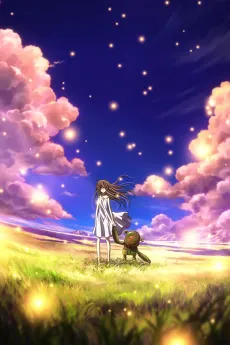
Tomoya takes the weakened Ushio outside in the snow, desperate to fulfill her wish to go on a trip together. She collapses. In his arms, in the falling snow, Ushio dies — mirroring Nagisa's death almost exactly. Tomoya, broken beyond repair, collapses beside her. The screen fades to white.These episodes interweave with the “Illusionary World” — a parallel storyline running throughout both seasons featuring a girl and a robot made of junk in an empty, dying world. The girl has been collecting light orbs, and the robot sacrifices itself to give her one final wish.
The Miracle & Resolution (Episodes 22–24)
The supernatural thread that has been quietly running since the first season finally pays off. The light orbs — born from moments of genuine happiness and fulfilled wishes throughout the series — converge.
Major Spoiler — The Ending
Time rewinds to the moment of Ushio's birth. This time, Nagisa survives. Tomoya holds his newborn daughter and his living wife, weeping with a joy that carries the weight of an entire alternate timeline of suffering. The orbs of light, collected through every act of kindness Tomoya performed across both seasons, have granted the ultimate wish. It's not a simple reset — it's a reward earned through an entire series' worth of compassion, connection, and pain.The final episodes include an epilogue showing the extended cast living their lives — a warm, gentle exhale after the most emotionally intense journey in the medium.
Highlights & Must-See Moments
- Episode 16: The Snowstorm Birth — The scene that breaks everyone. Kyoto Animation’s restrained direction makes it hit harder than any dramatic flourish could.
- Episode 18: The Flower Field — Tomoya’s breakdown with Ushio is the emotional axis of the entire series. Five years of suppressed grief released in a single embrace.
- Episode 19: The Train Station — Tomoya’s farewell to his father is a masterclass in showing how forgiveness doesn’t erase pain but transforms it.
- Episode 21: The Final Snow — A mirror of Episode 16 that proves the show can break your heart the exact same way twice.
- Episode 22: The Light Orbs Converge — The payoff to a two-season supernatural mystery that recontextualizes every side story and kind act.
Our Take
Clannad: After Story is the rare anime that earns its reputation not through spectacle but through patience. The first eight episodes are often criticized as slow, but they’re doing essential work — building the light orb mythology and grounding us in a world where kindness has tangible, supernatural weight. When the series pivots to adulthood, it enters territory almost no anime dares to explore: the grinding reality of working-class life, the terror of parenthood, and the way grief can hollow out a person for years.
Comparisons to Your Lie in April or Anohana are inevitable, but After Story operates on a different scale entirely. Those series tell stories about loss; After Story tells a story about what happens after loss — the years of numbness, the slow return to living, and the terrifying possibility of losing again. The supernatural ending is divisive, but it works precisely because it’s not free. Every orb was earned across 50 episodes of Tomoya choosing to help people even when he had nothing. Kyoto Animation’s craft is impeccable throughout — Dango Daikazoku will never sound the same after this.
Rating: 9.3 / 10 — A devastating, deeply human masterpiece that defines what anime drama can achieve.
Where to Watch & Read
- Watch on HiDive
- Watch on Apple TV
- Clannad Official Anthology Comic — Shop on Amazon
- Clannad Visual Novel by Key — Shop on Amazon
- Dango Daikazoku Plush Set — Shop on Amazon