Edited by Hong-Bin Yoon · Founder, zzinDev LLC
Published
Kizumonogatari Part 3: Reiketsu Season 1 Recap
Spoiler Alert: This recap contains detailed plot summaries and may reveal key story events.
TL;DR
Kizumonogatari Part 3: Reiketsu is the devastating finale of the Kizumonogatari film trilogy, transforming what seemed like a straightforward rescue mission into a gut-wrenching moral crisis. After Koyomi Araragi successfully recovers all of Kiss-Shot’s limbs, he’s forced to confront the horrifying reality of what he’s actually restored — a god-tier predator who devours humans without remorse. This film is less action spectacle and more psychological knife-twist, culminating in one of the most emotionally complex resolutions in all of anime. If you’ve watched Parts 1 and 2, Reiketsu is where everything clicks into place — and where Araragi and Shinobu’s centuries-long bond is truly forged.
Season Summary
The Hollow Victory (Opening)
Kizumonogatari Part 3: Reiketsu picks up immediately after Araragi’s hard-fought victory over the three vampire hunters — Dramaturgy, Episode, and Guillotine Cutter. He’s battered and exhausted but triumphant, carrying all four of Kiss-Shot Acerola-Orion Heart-Under-Blade’s severed limbs back to the abandoned cram school. Meme Oshino watches from the sidelines with his characteristic detachment, having orchestrated the conditions for these fights without ever truly taking a side.
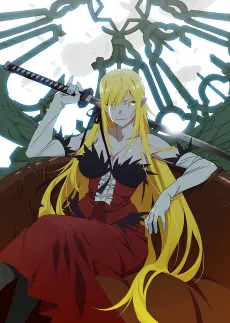
Araragi expects a simple exchange: return Kiss-Shot’s limbs, she restores his humanity, and everyone goes home. But the moment Kiss-Shot reassembles herself — regenerating into her full, terrifyingly beautiful adult form — the atmosphere shifts entirely. This isn’t the helpless, dying girl Araragi saved under the streetlamp. This is a 500-year-old apex predator radiating power, and her first act is not gratitude but hunger.
The Cold Truth (Core Conflict)
The emotional core of this Kizumonogatari Part 3: Reiketsu season 1 recap centers on a single devastating revelation. Kiss-Shot, now fully restored, casually reveals what Araragi should have understood from the beginning: vampires feed on humans. Not metaphorically, not occasionally — it is their fundamental nature. She demonstrates this by consuming the remains of Guillotine Cutter, the vampire hunter who had been defeated earlier, treating the act as perfectly natural.
Araragi is shattered. He realizes that by saving Kiss-Shot, he hasn’t performed a heroic act — he’s unleashed a monster back onto the world. Every human she kills from this point forward is blood on his hands. The guilt is compounded by his own vampiric nature; he’s been drinking Hanekawa’s blood throughout the trilogy, and the line between himself and the creature he now fears is thinner than he wants to admit.
This section of the film is brutally introspective. Araragi spirals into self-loathing and paralysis, unable to reconcile his desire to save someone with the consequences of having done so. Oshino, ever the neutral party, refuses to offer easy answers, only pointing out that Araragi made his choice and must now live with it.
Hanekawa’s Gambit (The Plan)
Tsubasa Hanekawa — who has been Araragi’s steadfast anchor throughout the trilogy — finds him at his lowest point and presents a plan. Her proposal is as logical as it is desperate: if Araragi fights Kiss-Shot and drains her to near-death, weakening her to the point where she can no longer sustain herself as a full vampire, a middle ground might be possible. Neither fully human nor fully vampire — a compromise that lets both of them survive.
What makes Hanekawa’s role so compelling here is her selflessness layered over something more complex. She’s already been bitten by Araragi, already entangled in the supernatural world because of him, and yet she approaches the problem with methodical clarity. The film hints at the emotional weight she carries — feelings for Araragi that she buries under practicality — but never lets the romance overshadow the crisis.
Araragi accepts the plan, not because he believes in it, but because doing nothing means accepting a world where Kiss-Shot hunts freely.
The Final Battle (Climax)
The climactic confrontation between Araragi and Kiss-Shot is one of the most visually stunning and thematically rich sequences Shaft has ever produced. It takes place in a wide-open field under a blood-red sky, and it is savage — not elegant swordplay but raw, desperate, regeneration-fueled brutality. Limbs are torn off and regrown. Bodies are shattered and reformed. It’s a war of attrition between two vampires who can’t truly kill each other.
Major Spoiler
But the real twist is Kiss-Shot's intent. As the fight drags on, Araragi begins to realize that Kiss-Shot isn't fighting to win — she's fighting to die. She engineered this entire scenario. She allowed herself to be weakened, allowed Araragi to fight the hunters, knowing that a restored Araragi would eventually have to confront what she truly is. Kiss-Shot has been alive for 500 years, and she is tired. She wanted Araragi to be her executioner, the person who would finally end her existence with a clear conscience. Her cruelty in eating Guillotine Cutter wasn't casual indifference — it was a performance designed to make Araragi hate her enough to strike the killing blow.This revelation recontextualizes the entire trilogy. Every interaction, every moment of vulnerability Kiss-Shot showed, was part of a being who had already decided she wanted to die but needed someone compassionate enough — and strong enough — to do it.
The Compromise (Resolution)
Araragi cannot kill her. Despite everything, he refuses to be her executioner. He’s seen too much of who she is beneath the monster — the lonely, ancient girl bleeding out under a streetlamp who asked a stranger to save her life.
Major Spoiler
Oshino brokers the final compromise. Araragi drains Kiss-Shot of nearly all her power, reducing her from a god-tier vampire to a shadow of herself — a small, childlike form with almost no strength. In return, Araragi retains trace vampiric abilities but is functionally human again. The cost is that they are bound together permanently. Kiss-Shot — now "Shinobu Oshino," named by Meme — must feed on Araragi's blood to survive, and he must live knowing that his continued existence sustains the creature he both saved and condemned.The film ends not with triumph but with a quiet, melancholic acceptance. Araragi walks away from the cram school carrying the weight of a decision that will define every relationship and supernatural encounter in the Monogatari series to come. His bond with Shinobu — resentful, codependent, and strangely tender — becomes the emotional backbone of the entire franchise.
This Kizumonogatari Part 3: Reiketsu season 1 summary captures what makes the film so powerful: there are no heroes, no villains, only people (and monsters) trapped by their own loneliness.
Highlights & Must-See Moments
- Kiss-Shot’s restoration scene — The visual transformation from the dying girl to her full adult form is breathtaking, and the tonal shift it triggers is masterfully handled.
- The Guillotine Cutter revelation — The moment Araragi realizes what he’s done is the emotional gut-punch the entire trilogy has been building toward.
- Hanekawa’s confession of a plan — Her quiet determination in the face of an impossible situation cements her as one of the series’ most compelling characters.
- The final battle — Shaft pulls out every visual trick in its arsenal for a fight that’s less about spectacle and more about two broken people destroying each other because they don’t know how to communicate.
- The ending compromise — The birth of “Shinobu Oshino” is simultaneously heartbreaking and beautiful, a resolution that refuses to be clean or satisfying.
Our Take
Reiketsu is the rare anime film that retroactively improves everything that comes after it. If you’ve watched Bakemonogatari or any later Monogatari entry and wondered why Araragi and Shinobu’s relationship carries such weight — why there’s resentment and tenderness in equal measure — this film is the answer. It turns what could have been a simple vampire action trilogy into a meditation on guilt, mercy, and the impossible ethics of saving someone who doesn’t want to be saved.
Compared to other franchise origin stories, Reiketsu stands alongside works like Fate/Zero in its willingness to let the prequel be darker and more morally ambiguous than the main series. Shaft’s visual direction — all stark compositions, abstract architecture, and bold color palettes — has never been more purposeful. Every stylistic choice serves the emotional claustrophobia of Araragi’s dilemma. The film’s cultural impact within the Monogatari fandom is enormous; it transformed Shinobu from a fan-favorite side character into one of anime’s most tragic figures.
Rating: 9.0 / 10 — A masterful, emotionally devastating conclusion that earns every ounce of its payoff.
Where to Watch & Read
- Watch on Amazon Prime Video
- Watch on Netflix (availability varies by region)
- Source material: Light novel — Kizumonogatari is a single volume in the Monogatari Series by NISIOISIN
- Kizumonogatari Wound Tale Light Novel by NISIOISIN — Shop on Amazon
- Kizumonogatari Part 3 Reiketsu Blu-ray — Shop on Amazon
- Monogatari Series Box Set Light Novels by NISIOISIN — Shop on Amazon