Edited by Hong-Bin Yoon · Founder, zzinDev LLC
Published
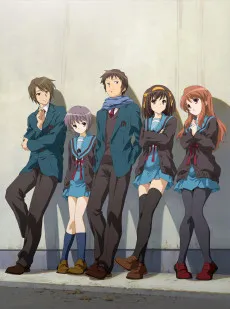
The Disappearance of Haruhi Suzumiya Season 1 Recap
Spoiler Alert: This recap contains detailed plot summaries and may reveal key story events.
TL;DR
The Disappearance of Haruhi Suzumiya isn’t a season — it’s a standalone 2-hour and 42-minute film, and it’s one of the greatest anime movies ever made. Kyon wakes up on December 18th to find that Haruhi Suzumiya has vanished from existence, the SOS Brigade never formed, and the supernatural world he’d grown so accustomed to has been completely erased. What follows is a gripping mystery-thriller wrapped in an unexpectedly emotional character study, as Kyon races to restore his reality. If you’ve watched The Melancholy of Haruhi Suzumiya, this film is the essential payoff — a masterpiece of sci-fi storytelling from Kyoto Animation at the peak of their craft.
Season Summary
The Disappearance of Haruhi Suzumiya is a feature film rather than a traditional season, but its nearly three-hour runtime gives it the depth and scope of a full arc. This Disappearance of Haruhi Suzumiya season 1 summary covers the complete story from beginning to end.
The World Gone Wrong (Opening – ~30 min)
It’s mid-December, and the SOS Brigade is gearing up for a Christmas party. Haruhi is her usual domineering self, assigning tasks and demanding everyone participate. Kyon grumbles as always, but things feel comfortably routine — hotpot plans, costume fittings for Mikuru, the works.
Then, on December 18th, everything changes. Kyon arrives at North High to discover a world that has been fundamentally rewritten. Haruhi Suzumiya is not in class. She doesn’t attend this school. According to everyone around him, she never has. Taniguchi and Kunikida have no idea who she is. Mikuru Asahina is a timid upperclassman who has never met Kyon. Itsuki Koizumi and his entire class have transferred away.
Most unsettling of all, Yuki Nagato is still in the literature club room — but she’s not the stoic, omnipotent humanoid interface Kyon knows. She’s a shy, quiet, ordinary human girl with reading glasses who blushes when Kyon speaks to her. The SOS Brigade never existed. The supernatural world — espers, time travelers, aliens — has been completely erased. Kyon is the only person who remembers any of it.
The Investigation (~ 30–80 min)
Kyon spirals through confusion and denial before shifting into detective mode. He methodically checks every lead: visiting Koizumi’s old school (transferred months ago to a different city), seeking out Mikuru (who is bewildered by this stranger), and searching for any trace of Haruhi. His investigation leads him to discover that Haruhi is attending Kouyouen Academy — the rival all-girls school — alongside a very human Itsuki Koizumi.
A crucial clue arrives when Kyon discovers a bookmark left in a library book by the altered Nagato. This leads him to the SOS Brigade clubroom computer, where he finds a message from the original Yuki Nagato — a program she embedded before the world was rewritten. The message contains an escape program and a critical revelation about what happened.
The truth is staggering.
Who Altered the World
It was Yuki Nagato herself — the original, alien-interface Yuki — who rewrote reality. After three years of silently observing, obeying orders, and accumulating “errors” (essentially emotions), she reached a breaking point. Using Haruhi’s godlike powers, which she briefly seized, Nagato reconstructed the entire world into one without supernatural elements — a normal world where she could simply be a quiet girl in a book club. It wasn’t malice. It was exhaustion, loneliness, and a desperate wish to be human.This revelation reframes the entire franchise. The character everyone assumed was an emotionless tool had been quietly suffering all along.
The Choice (~ 80–110 min)
Armed with Nagato’s escape program, Kyon faces the film’s emotional centerpiece: a genuine choice. He can activate the program and restore the original world — with all its chaos, danger, and Haruhi’s unpredictability — or he can stay in this peaceful, normal reality. No aliens. No time travel. No existential threats. Just an ordinary high school life.
The altered world is, by most measures, better. It’s safer. And the human Nagato in this world is gentle, endearing, and clearly developing feelings for Kyon. Staying would be the rational choice.
What follows is one of the most celebrated monologues in anime.
Kyon’s Decision
Kyon engages in a brutally honest internal debate, pacing the empty clubroom. He admits he’s been lying to himself the entire series — all his complaints about Haruhi, his protests about being dragged into supernatural nonsense, his claims that he wanted a normal life. Standing at the crossroads, he finally confronts the truth: he loves this insane world. He chose it. He kept choosing it every single day. He wants Haruhi back. He wants the SOS Brigade. He slams his hand on the enter key and activates the restoration program.This sequence is the thematic climax of the entire Haruhi franchise — the moment Kyon stops being a passive narrator and becomes an active protagonist who owns his decisions.
The Time Travel Gambit (~ 110–145 min)
Activating the program isn’t enough on its own. Kyon is thrust into a time-travel operation that loops back through events from the original series — specifically the Bamboo Leaf Rhapsody episode. He must work alongside a past version of Mikuru (the adult, time-traveling version) and coordinate with Nagato to inject a corrective data payload at the exact moment the world was altered.
The sequence is a masterclass in payoff. Plot threads seeded episodes (and years) earlier snap into place. Kyon realizes that the “John Smith” identity he used when he met a younger Haruhi — an event from the TV series — was always a predestination loop anchored to this very crisis.
The Stabbing
During the restoration process, Kyon is attacked and stabbed by an agent connected to the altered timeline — a version of Ryoko Asakura, Nagato's former backup who had tried to kill Kyon in the original series. He nearly bleeds to death in a school hallway. He's saved only by a future version of himself and Mikuru, who anticipated the attack — another closed time loop.Resolution and Aftermath (~ 145 min – End)
Kyon wakes up in a hospital bed on December 21st. The world is back to normal. Haruhi is at his bedside, annoyed that he got himself hurt. The SOS Brigade is intact. Koizumi is smug. Mikuru is worried. Everything is as it was.
But Kyon visits Nagato in the literature club room, and the conversation is quiet, loaded, and devastating. He knows what she did. She knows he knows. He tells her that the SOS Brigade would not be the same without her — that he would not want a world without her in it. It’s not absolution, exactly, but it’s an acknowledgment that her feelings mattered, that her suffering was seen.
The film closes with the SOS Brigade’s Christmas party finally happening — hotpot, costumes, and all. Kyon narrates with a warmth he’d never have admitted to at the start of the series. The world is chaotic, dangerous, and utterly absurd. He wouldn’t have it any other way.
Highlights & Must-See Moments
- Kyon’s Clubroom Monologue — The emotional core of the entire film. Kyon’s internal battle over whether to restore the world is raw, honest, and redefines his character permanently.
- Meeting the Altered Nagato — The shy, glasses-wearing human Nagato is heartbreaking precisely because you understand why she wanted this. Her library card application scene is quietly devastating.
- The Revelation of Who Changed the World — A twist that recontextualizes every silent moment Nagato had across the entire TV series. Masterful long-form storytelling.
- The Time-Travel Sequence — Callbacks to Bamboo Leaf Rhapsody and earlier episodes land with incredible precision. Proof that Tanigawa and KyoAni planned this from the start.
- The Hospital Visit with Nagato — Understated and emotionally complex. No big speeches — just two people acknowledging something painful and choosing to move forward together.
Our Take
The Disappearance of Haruhi Suzumiya is that rare anime film that elevates everything that came before it. The TV series was clever and entertaining but often experimental to a fault (Endless Eight, anyone?). The movie takes all that accumulated goodwill — and frustration — and channels it into a story with genuine emotional stakes. It’s essentially Kyoto Animation’s thesis statement on what the studio does best: meticulous visual storytelling, atmospheric pacing, and character animation so detailed that a shy girl adjusting her glasses communicates more than most anime convey in entire arcs.
The film also stands as one of the strongest sci-fi narratives in anime. The time-travel mechanics are airtight, the mystery unfolds with perfect pacing across nearly three hours, and the central question — would you choose an extraordinary, dangerous life over a safe, ordinary one? — resonates far beyond its genre. Compared to other franchise-capping films like End of Evangelion or Madoka Magica: Rebellion, Disappearance earns its emotional climax through character honesty rather than spectacle. It’s the gold standard for how to adapt a light novel arc into film, and it remains Kyoto Animation’s crowning achievement in feature-length storytelling.
Rating: 9.4 / 10 — A near-flawless film that transforms a good franchise into a great one.
Where to Watch & Read
- Watch on Funimation
- The Disappearance of Haruhi Suzumiya Blu-ray — Shop on Amazon
- The Disappearance of Haruhi Suzumiya (Light Novel) by Nagaru Tanigawa — Shop on Amazon
- Haruhi Suzumiya Series Complete Light Novel Box Set — Shop on Amazon
- Nagato Yuki Nendoroid Figure — Shop on Amazon