Edited by Hong-Bin Yoon · Founder, zzinDev LLC
Published
BOCCHI THE ROCK! Season 1 Recap
Spoiler Alert: This recap contains detailed plot summaries and may reveal key story events.
TL;DR
BOCCHI THE ROCK! season 1 is the story of Hitori “Bocchi” Gotou, a devastatingly shy guitar prodigy who gets roped into a struggling high school band and slowly learns that music is better when you’re not alone. What sounds like a standard cute-girls-doing-cute-things setup is elevated by genuinely inventive animation, surprisingly sharp comedy, and an emotionally honest portrayal of social anxiety. This BOCCHI THE ROCK! season 1 recap covers the full journey from Bocchi’s closet to the stage — and if you haven’t watched it yet, you absolutely should.
Season Summary
This BOCCHI THE ROCK! season 1 summary follows Hitori Gotou’s transformation from an isolated bedroom guitarist into a functioning (barely) member of Kessoku Band across twelve episodes of comedy, panic attacks, and surprisingly moving musical performances.
The Closet Guitarist Gets Recruited (Episodes 1–3)
Hitori Gotou has spent her entire middle school career practicing guitar alone in her room for six hours a day, uploading anonymous covers to the internet as “Guitar Hero.” She’s racked up followers but zero real-world friends. Now a first-year in high school, she’s no closer to her dream of playing in a band — she can barely speak to other humans.
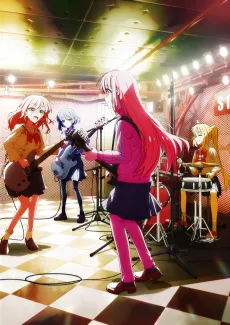
Everything changes when Nijika Ijichi, an energetic drummer desperately searching for a replacement guitarist, literally pulls Bocchi off the street and drags her to STARRY, a small live music venue owned by Nijika’s older sister Seika. There, Bocchi meets Ryou Yamada, the band’s cool and aloof bassist who has a talent for spending money she doesn’t have. Together they form the skeleton of Kessoku Band, though their first “performance” is a disaster — Bocchi plays from inside a cardboard box because she can’t face the audience.
The early episodes establish the show’s comedic engine: Bocchi’s catastrophic social anxiety collides with situations that force her to interact with people, and the results are both hilarious and painfully relatable. CloverWorks goes wild with the animation, depicting Bocchi’s inner turmoil through everything from claymation to abstract horror imagery.
Kita Joins and the Band Takes Shape (Episodes 4–6)
The final member arrives when Ikuyo Kita, a bubbly and outgoing first-year, joins as vocalist and rhythm guitarist. Kita had actually been in Kessoku Band briefly before Bocchi — she joined because she had a crush on Ryou, then immediately quit because she couldn’t actually play guitar. Now she’s back, still can’t really play, but she’s determined to stick it out this time.
Kita is Bocchi’s polar opposite: sociable, popular, and radiating main-character energy. Their dynamic becomes the emotional core of the show. Kita genuinely admires Bocchi’s guitar skills, while Bocchi is bewildered that someone so outgoing would want anything to do with her. The band finally has a full lineup, and they begin practicing in earnest at STARRY.
These middle episodes focus on the band learning to play together and Bocchi’s tentative steps toward friendship. She gets a job at STARRY (mostly standing frozen behind the counter), attempts to hand out flyers for their upcoming show (mostly standing frozen on the street), and slowly — painfully slowly — begins to open up. The show never treats her anxiety as something easily overcome; every small victory costs her enormous effort.
The Audition and Growing Pains (Episodes 7–9)
Kessoku Band faces their first real test: they need to pass an audition to earn a proper slot at a live event at STARRY. Seika isn’t going to give her little sister’s band a free pass. The pressure forces the group to confront their weaknesses — Kita’s rudimentary guitar skills, Bocchi’s inability to perform in front of others, and the band’s general lack of cohesion.
Major Spoiler
During the audition, Bocchi breaks a guitar string mid-performance. Rather than falling apart, she improvises a wild, unconventional solo that channels all her pent-up anxiety into raw musical energy. It's the first real glimpse of Guitar Hero emerging in a live setting, and it's enough to pass the audition.The band also deals with interpersonal growing pains. Bocchi agonizes over whether the others actually like her or just tolerate her. Ryou’s chronic money problems become a running gag with an undercurrent of real consequence. And Nijika works overtime as the group’s emotional glue, keeping everyone together while managing her own pressure as the band’s de facto leader.
Festival Arc and Finding an Audience (Episodes 9–10)
With a live show on the horizon, the band needs to actually attract an audience. This leads to some of the season’s funniest sequences, including Bocchi’s attempts at self-promotion that range from awkward to genuinely unhinged. The show leans hard into its comedy during this stretch, with Bocchi’s delusions and anxiety spirals reaching peak absurdity.
Bocchi also begins writing an original song for the band, pouring her feelings of isolation and longing for connection into lyrics. It’s a turning point — up until now, she’s been a technically brilliant player hiding behind covers and anonymity. Creating something original means putting her actual self out there, which is the scariest thing imaginable for someone who’d rather dissolve into the floor than make eye contact.
The Concert and Bocchi’s Breakthrough (Episodes 11–12)
The season builds to Kessoku Band’s performance at the STARRY cultural festival event. Everything that could go wrong threatens to — equipment issues, pre-show nerves, and Bocchi’s anxiety reaching critical mass. The day of the show is a pressure cooker.
Major Spoiler
Bocchi's guitar amp malfunctions during their performance, cutting her sound entirely. In a moment that mirrors and surpasses her earlier broken-string save, she makes a split-second decision: she plugs directly into the venue's sound system, essentially soloing over the entire band with raw, unfiltered guitar. It's messy and imperfect and completely electrifying. The audience — small as it is — goes wild.The finale doesn’t offer some fairy-tale transformation where Bocchi becomes a confident extrovert overnight. She’s still awkward. She still struggles. But she’s on stage, playing music with people who genuinely care about her, and for the first time in her life, she feels like she belongs somewhere. The season ends with Kessoku Band looking toward the future — more shows, more songs, and maybe, just maybe, more friends for Bocchi.
The final moments circle back to Bocchi’s online Guitar Hero persona, hinting that the gap between who she is online and who she’s becoming in real life is starting to close. It’s a quietly powerful ending for a show that earns every bit of its emotional payoff.
Highlights & Must-See Moments
- Episode 1: The cardboard box performance — Bocchi plays her first “live” show hidden inside a box, and it’s both the funniest and saddest scene of the premiere. The perfect thesis statement for the entire show.
- Episode 5: Bocchi tries to hand out flyers — A masterclass in cringe comedy as every possible social interaction goes wrong in increasingly creative ways. The animation shifts into genuinely surreal territory.
- Episode 8: The broken string improvisation — Bocchi’s audition save is the moment the show reveals its emotional hand. Underneath the comedy, this is a story about talent finding its way past fear.
- Episode 12: The finale performance — Everything the season has been building toward pays off in a concert sequence that’s gorgeously animated and genuinely moving. CloverWorks went all out.
- Episode 3: Bocchi’s “resolution” face — A brief moment where the animation style shifts to unsettling photorealism to depict Bocchi’s determination. It lasts two seconds and is burned into every viewer’s memory.
Our Take
BOCCHI THE ROCK! arrived in Fall 2022 and immediately set itself apart from the crowded music-anime genre. Where K-On! made band life cozy and aspirational, Bocchi makes it feel like an act of survival for its protagonist. The show’s secret weapon is its refusal to trivialize social anxiety — Bocchi’s struggles are played for comedy, yes, but the comedy comes from recognition, not mockery. Anyone who’s ever rehearsed a conversation in their head only to freeze in the moment will feel seen.
CloverWorks deserves enormous credit for the animation, which is some of the most creative and expressive work in recent TV anime. The studio throws every technique imaginable at Bocchi’s mental state — stop-motion, live-action inserts, paint-on-glass, even what appears to be MS Paint — and it all works because it’s in service of character, not spectacle. The music is excellent too, with Kessoku Band’s tracks holding up as genuinely good rock songs outside the context of the show. In a season that also featured heavy hitters like Chainsaw Man and Mob Psycho 100 III, BOCCHI THE ROCK! quietly became the most beloved anime of Fall 2022, and it earned every bit of that reputation.
Rating: 9.0 / 10 — A near-perfect blend of comedy, heart, and visual creativity that redefines what a music anime can be.
Where to Watch & Read
- Watch on Netflix
- Watch on HiDive
- Bocchi the Rock! Vol. 1 by Aki Hamaji — Shop on Amazon
- Kessoku Band Bocchi the Rock! Soundtrack Album — Shop on Amazon
- Bocchi the Rock! Hitori Gotou Nendoroid Figure — Shop on Amazon